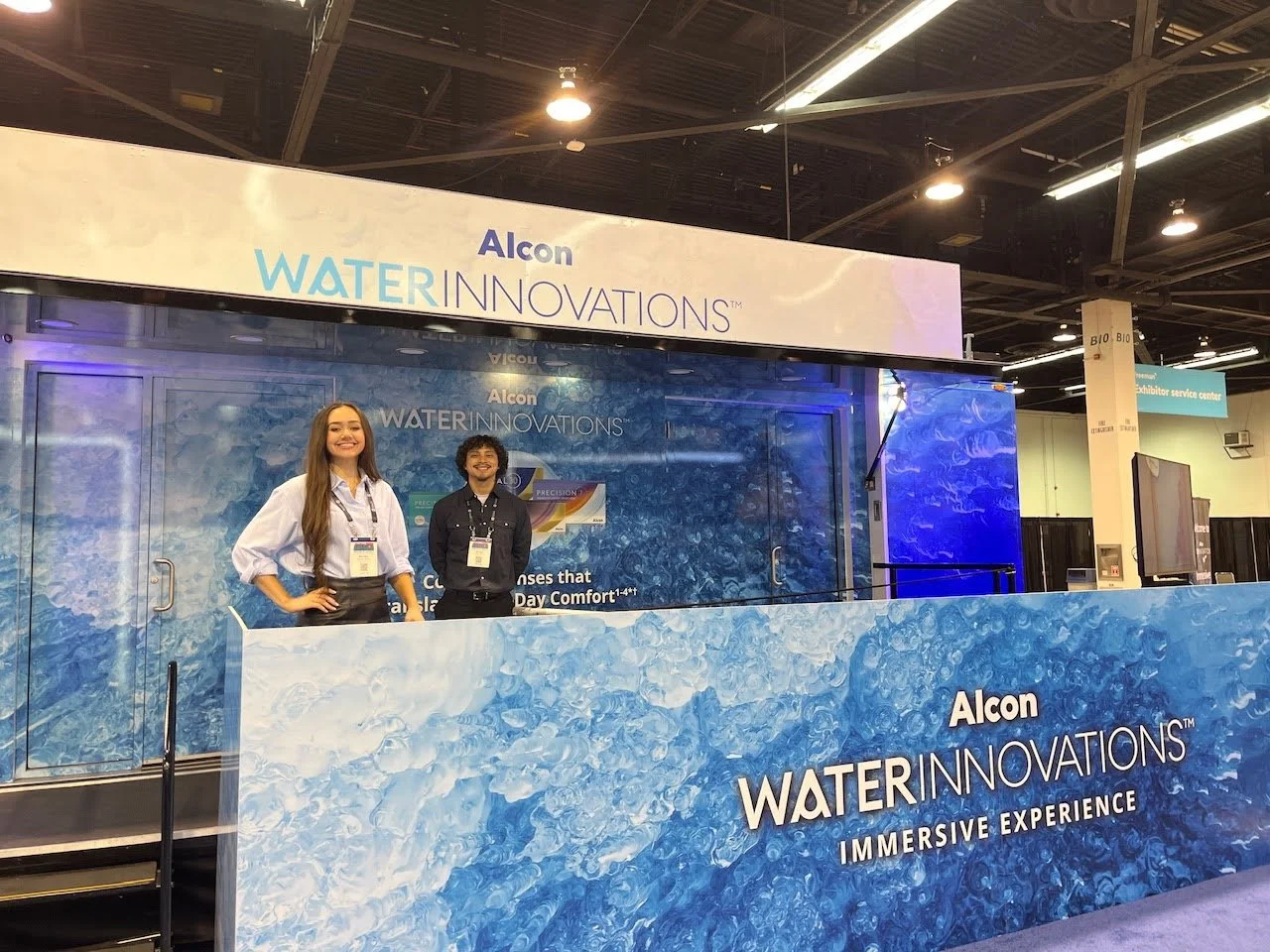
Our Brand Ambassadors engaging attendees at Alcon’s activation.
Your trade show booth is often the first point of contact between your brand and potential customers. The right staff can make all the difference, creating a welcoming environment, answering product questions, capturing leads, and allowing your sales team to focus on conversations that drive business forward.
That’s why effective trade show staffing is essential for exhibitors at major industry events. It’s about having the right people in the right roles to match your booth size, expected foot traffic, product complexity, and lead-generation goals. At Encore Nationwide, we’ve been providing event staffing solutions since 1998, supporting everything from large conference programmes to exhibitions that require registration staff, greeters, directional staff, sales associates, and dedicated booth teams.
So if you’re preparing for a major trade show or a specialised industry exhibition, as Encore Nationwide, we provide reliable trade show staffing solutions to help your brand make the most of every opportunity, nationwide.
How Many Booth Staff You Need by Booth Size
There is no universal staff-to-square-foot ratio for trade show booths. A booth with one product demo station and a steady flow of qualified buyers needs a different team than a high-traffic booth built around sampling, giveaways, or short brand interactions.
Start with what happens inside the booth. Think about how many entrances you have, whether guests need to be greeted, how long a typical conversation lasts, whether there is a demo or meeting area, and how you will capture lead details.
For a small 10-by-10 booth, two people are often enough when the goal is simple: one person can greet and qualify visitors while the other holds product conversations or takes meetings. If the booth includes a demonstration, one of those people should be able to lead it without leaving the entrance unattended.
A 10-by-20 booth often needs three to four people during busy periods. This can give you a greeter at the edge of the space, a person responsible for lead capture, and one or two product specialists or sales representatives ready for deeper conversations.
For a 20-by-20 booth or larger, plan around activity zones rather than the total floor space. A booth with separate demo stations, meeting tables, product displays, hospitality service, and multiple open sides may need five or more people. The goal is to avoid a situation where one staff member is caught in a long conversation while new visitors walk past unnoticed.
These are planning guidelines, not a fixed industry rule. The right headcount depends on your show objectives and the way visitors will move through your booth. Before booking, map each point where a guest needs attention: entry, product interaction, demo, lead capture, meeting area, and exit.
The Roles a Booth Needs
A strong booth team is built around clear responsibilities. When every person is expected to do everything, the welcome can get missed, lead capture becomes inconsistent, and your best product experts spend too much time answering basic questions.
Greeters
Greeters are the first people attendees notice. Their job is to acknowledge visitors, offer a simple opening line, and make the booth feel approachable. They can ask a quick qualifying question, explain what is happening in the space, and direct people to the correct team member.
Greeters are especially useful for large or open booth layouts where attendees can enter from more than one side. They also help during peak traffic periods, when salespeople may already be speaking with qualified prospects.
Lead Capture Staff
Lead capture staff focus on making sure valuable conversations do not disappear when the show floor gets busy. They can scan badges, collect contact details, record interest areas, and note the next action needed after the show.
This role is valuable when your salespeople need to stay focused on a product discussion or meeting. It also helps you create cleaner data for post-show follow-up, rather than trying to piece together scattered notes at the end of a long day.
Product Specialists
Product specialists need enough product knowledge to explain the offer clearly and answer common questions. Depending on your program, they may lead demonstrations, walk attendees through a platform, explain features, or show how a product solves a specific problem.
For technical, high-value, or highly regulated products, this role may need to be handled by someone from your internal team. For a straightforward product story, trained booth staff can cover introductory information and pass more detailed conversations to your sales team.
Trade Show Models
Trade show models can help create a polished first impression, especially for programs where presentation, hospitality, and visual alignment are important. They may greet attendees, invite people into the booth, distribute materials, support product displays, and direct visitors to the appropriate team member.
They are not a replacement for knowledgeable salespeople or product specialists. Their value comes from supporting guest flow and ensuring the booth feels welcoming while your subject-matter experts focus on deeper conversations.
For larger programs that require roles beyond the booth, Encore also works as an event staffing agency, supporting registration, guest services, product specialists, supervisors, and other event-day staffing needs. Encore’s live service page notes that its staff can support B-to-B and B-to-C events with roles including trade show ambassadors, registration staff, managers, and product specialists
Booth Staff vs. Sending Your Sales Team
Your sales team belongs at the show. They know your buyers, understand objections, and can have the conversations that move opportunities forward.
The problem is expecting them to do every job at once.
When salespeople are responsible for greeting every visitor, scanning badges, handing out materials, running demos, managing meetings, and answering product questions, they can end up spending less time with the people most likely to buy. The booth can also feel unwelcoming when a visitor arrives and no one is available to acknowledge them.
Booth staff give your sales team room to work at the right level. A greeter can start the interaction. Lead capture staff can record details. A trained product specialist can handle the initial explanation. Your salespeople can then step in when the conversation calls for a technical answer, commercial discussion, or scheduled meeting.
The best setup is usually a combination of internal expertise and outside support. Your staff owns the high-value conversations. The booth team protects the visitor experience around them.
Training Booth Staff on Your Product
You do not need a week-long training program to prepare booth staff for a show. With a clear brief and focused training, a team can learn the key points of a product in 48 hours.
Start with the one-sentence explanation. Every booth staff member should be able to explain what the product is, who it is for, and why someone should care. Avoid jargon and internal language that makes sense only to your company.
Next, give staff three to five approved talking points. These should be the benefits or differentiators you want attendees to remember. Add a short list of common questions, along with approved answers and clear instructions on what should be escalated to a product specialist or salesperson.
Then teach the guest journey. Staff should know how to greet people, what qualifying question to ask, how to identify a visitor who should speak with sales, how to capture a lead, and how to close the interaction professionally.
A productive 48-hour preparation process can look like this:
Day one: Share the product overview, target audience, key messages, event goals, and booth layout.
Day two: Run through common attendee conversations, lead-capture steps, product-demo basics, and escalation scenarios.
Show morning: Review the schedule, team roles, dress code, breaks, opening lines, and any last-minute updates.
Keep the materials practical. A short product guide, a list of approved answers, a contact sheet, and a clear booth map are more useful on show day than a long slide deck.
Booking Windows for Las Vegas, Chicago and Orlando Shows
Las Vegas, Chicago, and Orlando host major trade shows throughout the year, and January through March can be especially busy for exhibitors and event suppliers. That is not the time to wait until the last minute to confirm your booth team.
For a straightforward booth assignment, begin planning as soon as your show date, booth footprint, and basic schedule are confirmed. This gives you time to define the roles, prepare product training, finalize wardrobe, and build a team that fits the assignment.
For larger booths, multiple shifts, multilingual staffing, specialized product knowledge, or large conferences, start earlier. More lead time makes it easier to secure the right people and ensure the team receives a useful brief before they arrive at the convention center.
This is also the right time to confirm payroll responsibilities. If you are bringing on temporary staff directly, make sure you understand your classification, payroll, and insurance obligations. For additional support, our outsourced payroll services help organizations manage event payroll; confirm tax and employment requirements with your legal or tax advisor.
Measuring What the Booth Team Delivered
A booth team should be measured against the job you hired them to do. Avoid treating headcount alone as the outcome.
For a lead-generation booth, review the number of scanned badges, qualified leads, meetings scheduled, demos completed, and follow-up actions assigned. For a product launch, look at demonstrations delivered, samples distributed, sign-ups, or visitor interactions. For a hospitality-focused booth, consider guest flow, registration accuracy, wait times, and whether attendees reached the right person without delay.
Set those expectations before the show. If the team knows that lead quality matters more than raw badge scans, they can ask better qualifying questions. If your priority is appointment setting, they can focus on the schedule rather than simply increasing traffic.
We supported Zumba’s instructor conferences and pop-up retail stores in Los Angeles and Orlando with more than 300 staff members in each market. The team included registration staff, directional staff, room monitors, managers, and sales associates for 35,000-square-foot pop-up retail stores. That scale reinforces an important point: once an event has multiple visitor touchpoints, staffing needs to be planned as an operational system, not as a last-minute booth task. Zumba Conference and Pop-Up case studyencorenationwide
For additional guidance on briefing and selecting event teams, read How to Hire Event Staff: A Brand’s Buyer’s Guide. For a closer look at the cost and responsibility side of direct hiring versus staffing support, see Temporary Event Staff: What Actually Costs Less?.
FAQ
How many staff do I need for a trade show booth?
It depends on the booth size, visitor volume, number of activity areas, product complexity, and whether your internal sales team will be present. A small booth may work with two people, while a larger booth with demos, meetings, or several open sides may need five or more people across the day.
What roles should a trade show booth have?
Most booths benefit from a greeter, lead capture support, and people who can explain the product or direct visitors to the right expert. Larger or more complex booths may also need product specialists, trade show models, demo staff, meeting coordinators, and a team lead.
Can booth staff learn our product in two days?
Yes, for an introductory role. A clear product overview, approved talking points, common questions, booth-flow training, and role-play practice can prepare staff to greet visitors, handle basic questions, and route detailed conversations to your subject-matter experts.
When should I book trade show booth staff?
Book as soon as your show date, city, booth size, schedule, and role requirements are confirmed. For January-to-March events in Las Vegas, Chicago, and Orlando, larger teams and more specialized roles should be planned well ahead of the show.
