
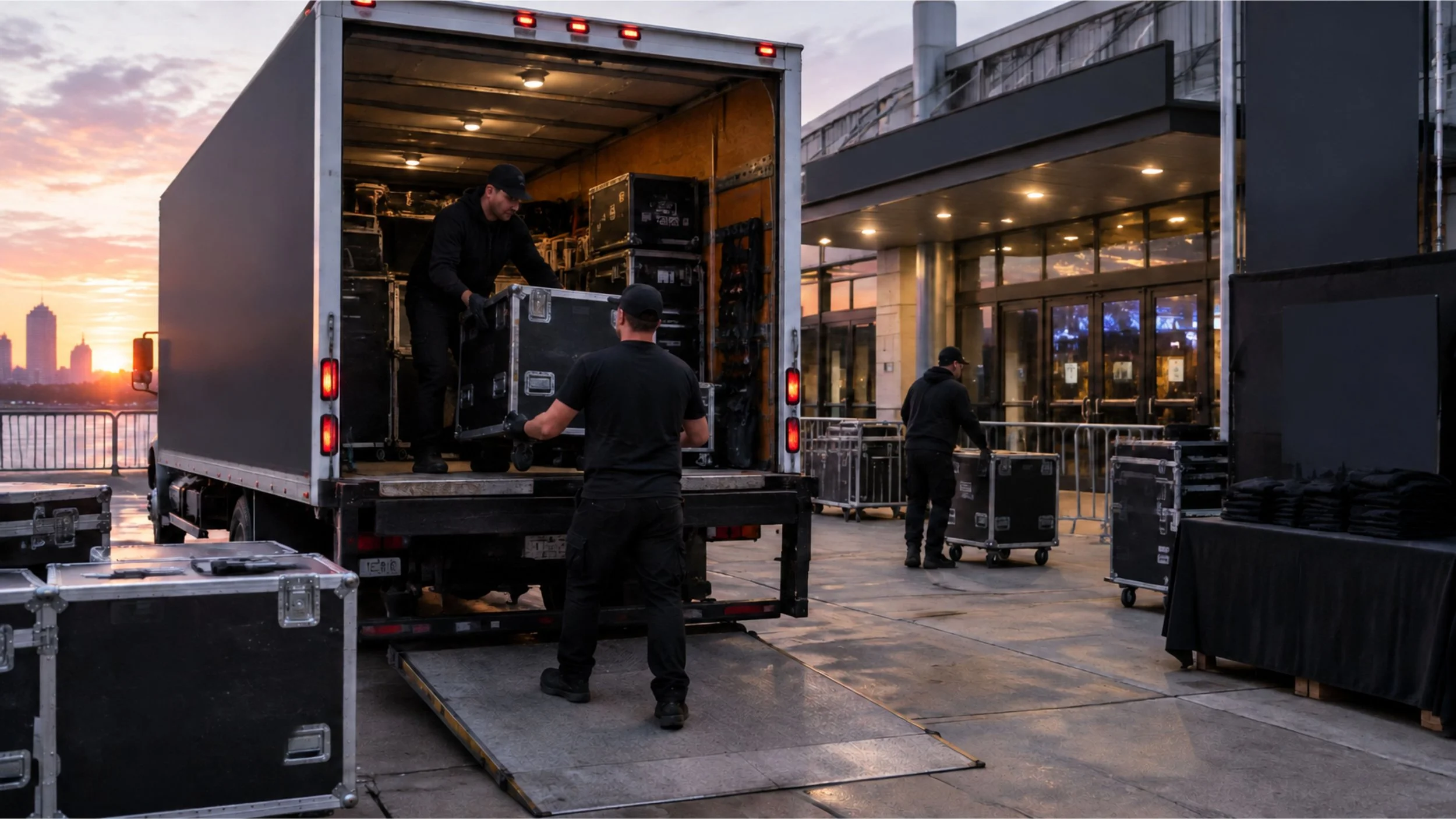
Event logistics
Event logistics is the planning and coordination that gets people, vehicles, equipment, permits, inventory, and staff to the right place at the right time—then gets everything out again. For brand marketers, festival producers, trade show exhibitors, conference organizers, and tour operators, it is the operational system behind every successful activation.
A great event idea does not move a truck, secure a permit, warehouse 400 sample kits, or find a CDL driver at 6 a.m. Logistics does. At Encore Nationwide, we have spent more than 25 years handling the back-end work that makes events possible: drivers, vehicles, warehousing, routing, travel, permits, load-in, setup, breakdown, and payroll.
This guide explains what event logistics means, breaks down the moving parts, gives you a practical event logistics checklist and planning timeline, and shows when it makes sense to hand the work to a logistics partner.
What Event Logistics Means
Event logistics is the management of every physical and operational detail required to execute an event. It covers how materials, vehicles, staff, equipment, permits, and information move before, during, and after an event.
It is different from event marketing. Marketing decides what the audience sees, hears, samples, and remembers. Logistics makes sure the booth arrives intact, the sampling product is chilled, the driver knows the route, the staff has uniforms, the permit is approved, and the truck can load out on time.
Event logistics management is the ongoing work of coordinating those details across vendors, venues, cities, and timelines. A strong logistics plan reduces surprises, protects the budget, and gives your on-site team a chance to focus on attendees rather than firefighting.
For a mobile tour, logistics might include a wrapped vehicle, a driver, a warehouse shipment, hotel bookings, a permit for a sampling activation, and a route that gets the team from Chicago to Minneapolis without missing a load-in window. For a conference, it might mean registration staff, directional signage, product inventory, room monitors, and a teardown plan before the venue closes.
The Parts Of Event Logistics
Event logistics is not one task. It is a set of connected decisions, and a problem in one area can affect every other part of the program.
Transportation
Transportation gets assets, staff, and equipment where they need to be. That can mean a single cargo van for a local activation or a fleet of trucks, trailers, and CDL drivers moving a national tour from market to market.
Good transportation planning considers vehicle size, driver requirements, load-in access, parking, fuel, maintenance, travel time, and DOT compliance. We provide CDL A and B drivers, vehicle procurement and leasing, graphic wrapping, DOT compliance support, and tour routing.
Storage And Fulfillment
Most events need more than what fits in a vehicle. Samples, uniforms, signage, displays, giveaways, replacement inventory, and technical equipment all need somewhere to live before they reach the field.
Warehousing and fulfillment include receiving shipments, counting inventory, building kits, storing assets, shipping to individual stops, tracking usage, and managing returns. The goal is simple: every field team receives the right materials, on time, in usable condition. We handle storage, shipping, and receiving through our national warehouse network.
Labor And Staffing
Logistics and staffing overlap constantly. Drivers, load-in crews, teardown teams, brand ambassadors, tour managers, registration staff, and local support all affect whether an event runs on schedule.
The staffing plan should match the operational plan. A team cannot set up a 20-foot display if the truck arrives late. A sampling program cannot open if the product, permits, refrigeration, and trained staff are not all in place. Our all-W-2 staffing model keeps event staff on our books, rather than transferring payroll and classification responsibilities to you.
Permits, Licenses And Compliance
Permits and licenses vary by city, venue, event type, vehicle size, footprint, and activity. Food and beverage sampling, alcohol promotions, parking, street closures, generator use, and venue-specific rules can all create requirements.
This is not paperwork for paperwork’s sake. A missing approval can delay setup, prevent a vehicle from parking where planned, or stop an activation before it starts. Our logistics team helps manage permits, licenses, and the operational details that are easy to underestimate until they become a problem.
Travel, Lodging And Per Diems
Multi-market programs need travel coordination. Staff need flights, hotels, ground transportation, schedules, per diems, and clear reimbursement rules.
Travel logistics also protects the program when plans change. A delayed flight, a hotel issue, or an extended event day can affect staffing coverage, payroll, and the next stop. Our travel desk books travel and lodging and manages per diems, staff purchases, and reimbursements.
Routing And Scheduling
Routing turns a list of cities into a realistic schedule. It accounts for drive time, venue access hours, load-in windows, teardown time, hotel availability, driver rest requirements, shipping deadlines, and backup time for weather or traffic.
A route that looks efficient on a map can still fail in real life if it leaves no time to unload, set up, staff the activation, and reset for the next market. We have built routes for more than 2,000 tours.
Event Logistics Checklist
Use this event logistics checklist before you lock a program plan. It works for a one-day activation, a conference, a festival footprint, or a multi-city tour.
Start with the fundamentals. Confirm the event date, location, audience, activation footprint, and budget. Identify every physical asset, including the vehicle, trailer, display, samples, signage, uniforms, technology, premium items, and replacement stock. Confirm venue access times, load-in doors, parking rules, power, Wi-Fi, storage space, and teardown deadlines.
Then decide who owns each responsibility. Your internal team, venue, production partner, staffing partner, and logistics partner all need clear roles. Build a contact sheet with names, phone numbers, arrival times, and escalation paths. Confirm insurance requirements, certificates, and any venue or city documentation needed before the program moves forward.
For transportation and assets, determine the number and type of vehicles required. Confirm whether the program needs CDL A or B drivers. Map routes, drive times, overnight stops, fuel plans, and contingency routes. Book vehicle rentals, leases, trailers, auto haulers, or graphic wraps early. Create an asset inventory, assign a person to verify it at every load-in and load-out, and plan where inventory will be stored between markets.
For staffing and on-site operations, build a staffing plan by role, shift, market, and date. Confirm arrival times, uniforms, training, check-in process, breaks, and backup coverage. Brief staff on the brand, product, audience, safety rules, and escalation process. Assign a field lead or tour manager with authority to solve problems on-site. Confirm payroll dates, timekeeping process, travel rules, and per diem policy. Prepare a daily run-of-show with setup, doors, activation hours, breaks, teardown, and departure times.
For permits and compliance, identify every city, venue, and activity-specific permit or license required. Confirm lead times for approvals, especially for sampling, alcohol, food, parking, or street-level activations. Keep copies of permits, insurance certificates, vehicle documents, and staff credentials accessible on-site. Confirm local rules before finalizing the route, sampling plan, or activation footprint, and have a contingency plan if an approval is delayed or denied.
For event day and teardown, arrive early enough to unload, stage equipment, and solve problems before doors open. Check inventory, signage, product supply, technology, uniforms, and staff attendance before the event starts. Hold a short morning briefing with the field team, track issues in real time, and photograph the setup and teardown condition of the space. Confirm every asset is packed, counted, and returned to the correct location. After each stop, debrief on what worked, what failed, and what needs to change before the next market.
How To Build An Event Logistics Plan
A useful event logistics plan is not a spreadsheet full of hopes. It is a sequence of decisions with owners, deadlines, and backup plans.
Start with the event brief. Write down the non-negotiables: dates, cities, venue requirements, audience size, activation footprint, product or sampling needs, staffing headcount, budget, and success metrics. Then work backward from event day. If the event opens at 10 a.m., when does the truck arrive? When does setup begin? When do staff check in? When does product need to be staged? When does teardown need to finish?
Map every dependency. List each task and identify what has to happen before it can start. A wrapped vehicle cannot leave until graphics are approved and installed. A sampling team cannot activate until product, permits, refrigeration, and staff are confirmed. A tour cannot reach the next city until teardown, travel time, driver hours, and hotel availability are realistic. A field team cannot check in until uniforms, credentials, training, and schedules are complete. Dependencies are where logistics programs usually break, so put a name and date next to every one.
Build a planning timeline that matches the scale of the program. At 12 to 16 weeks out, confirm dates, markets, venue requirements, budget, staffing scope, and major assets. At 8 to 12 weeks out, finalize routes, vehicle needs, warehouse plan, staffing headcount, travel plan, and permit requirements. At 4 to 8 weeks out, book vehicles, drivers, hotels, warehousing, shipments, and major permits, then confirm staff schedules and training.
At 2 to 4 weeks out, ship inventory, build event kits, finalize run-of-show documents, and confirm all approvals. One week out, reconfirm every arrival time, contact, delivery, staff shift, and contingency plan. During event week, track shipments, confirm staff, brief teams, and prepare on-site escalation contacts. After the event, complete teardown, return assets, reconcile inventory, process payroll, and document lessons for the next stop.
Common Failure Points And How To Avoid Them
Most event logistics failures are not dramatic. They are small handoffs that nobody owned.
Late or incomplete shipments can stall an activation. A missing banner, insufficient sample inventory, or incorrect uniform shipment creates problems before the first guest arrives. Avoid it by creating a master inventory list, assigning a fulfillment owner, and shipping replacement stock before the first market needs it.
Unrealistic routing is another common failure. A route that ignores load-in windows, teardown time, driver rest, traffic, and hotel availability creates a cascade of delays. Build routes around the real operating day, not just the distance between cities.
Permit surprises can stop a program before it starts. Requirements differ from one city or venue to the next. Start early, confirm requirements in writing, and keep documentation accessible to the on-site team.
Unclear ownership turns small issues into event-day failures. When one vendor assumes another has handled uniforms, another assumes the field manager has replacement supplies, and the transportation company has an old schedule, the field team pays the price. Assign one accountable owner for every operational category.
Staffing gaps matter too. A logistics plan that does not account for staff arrival, breaks, backup coverage, and payroll creates problems before the first guest arrives. Treat staffing as part of the logistics system, not a separate afterthought.
When To Hand Logistics To A Partner
You may be able to manage logistics internally for a single local event with a small footprint. But a partner becomes valuable when the program has multiple markets, specialized vehicles, CDL drivers, warehousing, permits, travel, payroll, or a schedule that changes quickly.
A full-service logistics partner coordinates the moving parts so your team can focus on the audience and the experience. We support transportation, drivers, warehousing, fulfillment, vehicle procurement, graphic wrapping, travel coordination, permits, DOT compliance, routing, and payroll.
For a closer look at what a full-service partner handles across a tour, read our guide to event logistics services.
How We Handle Event Logistics
We have driven the trucks, set up the tents, and loaded in at 3 a.m. We are the only staffing company owned by former tour managers, and that background shapes how we approach logistics.
For the Subaru Winterfest Lifestyle Tour, we supported the program with a tour manager, CDL drivers, traveling and local brand ambassadors, and labor. We leased the fleet—two F-350s, two F-450s, and a 24-foot box truck—sourced an auto hauler and cargo trailer, handled insurance and maintenance, and managed travel for up to 10 traveling staff. The program engaged about 3,000 attendees per day.encorenationwide
For Boston Beer Co. Tours, we supported Twisted Tea with tour managers and brand ambassadors, alcohol sampling within state regulations, tour vehicles, permits, and premiums. Across nine years of partnership, the program included more than 1,500 events, 435,000 samples, and more than 175,000 miles.encorenationwide
Those programs show what event logistics looks like in practice: not a checklist sitting in a folder, but vehicles, drivers, inventory, travel, permits, staff, and schedules working together across markets.
Event Logistics FAQ
What Is Event Logistics?
Event logistics is the planning and coordination required to move people, vehicles, equipment, inventory, permits, and information before, during, and after an event. It makes sure every operational detail is in place so the event can run on schedule.
What Does Event Logistics Include?
Event logistics commonly includes transportation, drivers, warehousing, shipping, inventory, staffing, load-in and teardown, permits, travel, lodging, per diems, routing, and compliance. The exact mix depends on the event type, footprint, and number of markets.
What Is An Event Logistics Checklist?
An event logistics checklist is a list of every asset, approval, person, vehicle, delivery, and deadline required to execute an event. It should include venue access, transportation, inventory, staffing, permits, travel, setup, teardown, and contingency plans.
When Should I Hire An Event Logistics Company?
Hire an event logistics company when your program involves multiple markets, specialized vehicles or drivers, warehousing, permits, travel coordination, payroll, or operational complexity that pulls your internal team away from the event itself.
Talk To Our Logistics Team
If you need drivers, warehousing, fulfillment, routing, permits, travel coordination, or trained event staff, talk to our logistics team. We will help you build a plan that gets your program where it needs to be—on time, fully supported, and ready to activate.
