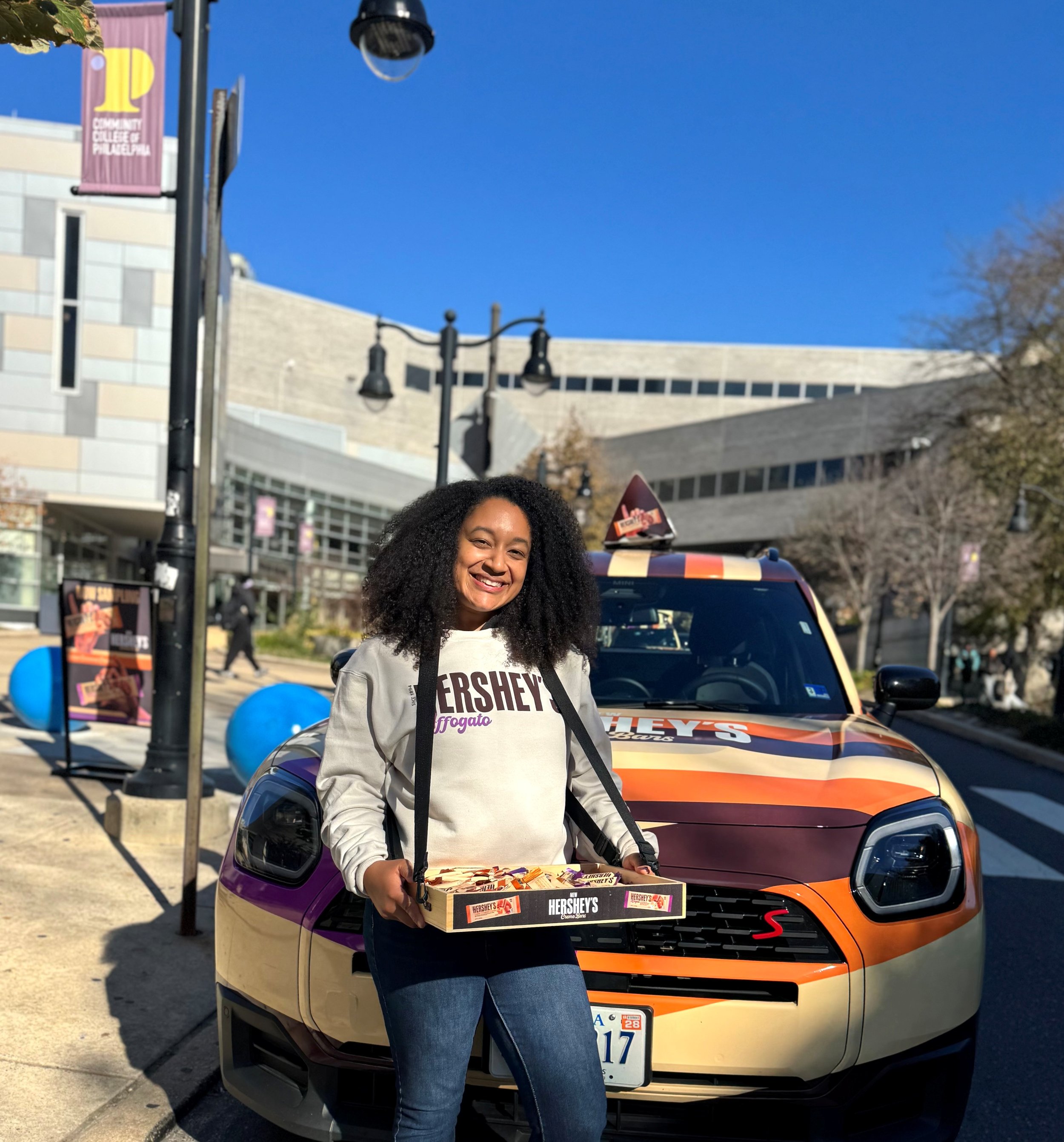
Brand ambassador event staffing for Hershey's Fall Tour in Philadelphia
Promo models and brand ambassadors do different jobs, and choosing the wrong one wastes money. Promo models are hired for presence, energy and foot traffic. Brand ambassadors are hired for product knowledge, conversation and lead quality. If you are a brand marketer, event producer or exhibitor deciding who to put on the floor, this guide breaks down where each role fits, how casting works and what to put in the brief. We have staffed both roles since 1998, so we will tell you plainly which one your event actually needs.
If you already know you need the visual, attention-drawing role, our promotional staff page covers how we cast and deploy it. If you need people who can carry a product conversation for ten minutes, keep reading.
What Promo Models Do
A promo model is hired to stop traffic. That is the job, and it is a real skill. They draw people toward a booth, a sampling station or a launch display, then hand off the conversation once interest is sparked.
You will see them at auto shows, spirits activations, retail launches and crowded trade show halls where standing out is the first hurdle. They greet, pose for photos, hand out samples, run a quick game and keep the energy high through an eight-hour floor shift. Trade show models are the specialized version of this role: they know booth choreography, badge scanning and how to work an aisle without blocking it.
What they are not trained to do is answer deep product questions. A good promo model knows your brand name, your tagline and two or three talking points. They are selected for presentation, poise and approachability, and they are usually booked for shorter engagements where visual impact matters more than education.
What Brand Ambassadors Do
A brand ambassador is hired to represent your brand as if they worked for you. They learn the product line, the competitive positioning and the objections. They can hold a real conversation, qualify a lead and close a sale without reading from a cheat sheet.
This is the role for products that need explaining. Think a new beverage with a functional ingredient story, a software platform at a conference, or a retail launch where staff have to answer ingredient and pricing questions all day. When you search for a brand ambassador for hire, you are usually buying product expertise and communication skill, not just presence.
We built our reputation on this role. Every ambassador on our books is a W-2 employee of Encore, which means they are trained, briefed and accountable to us rather than to a loose freelance network. That matters most on multi-city programs where consistency is the whole point.
Side by Side: When to Use Each
The cleanest way to choose is to ask what happens in the first thirty seconds of an interaction.
If the goal is to pull a stranger off the aisle and into your space, use a promo model. If the goal is to turn that stranger into a qualified lead or a sale, use a brand ambassador. If you have a big booth and a complex product, use both: models work the perimeter and the aisle, ambassadors work the demo station and the conversation.
Here is how that plays out by event type. At auto shows, promo models handle the crowd and the photo moments while product specialists answer technical questions. At spirits and beverage activations, models drive sampling volume and ambassadors handle brand story and responsible-service messaging. At retail launches, models create the spectacle and ambassadors manage the register, the product explanation and the waitlist. At trade shows, trade show models fill the booth and brand ambassadors qualify the leads your sales team will follow up on.
The Economist Tour shows what the ambassador model looks like when sales is the goal. We supplied event managers and brand ambassadors working to individual sales targets, paid every two weeks by Encore, across New York, Chicago and Washington, DC. Five staff per event, up to twelve activations a week, over a three-year partnership. That program needed people who could sell, not just smile. You can read the full The Economist Tour case study for the details.
Casting and Selection: What to Ask For
Casting is where most programs go wrong. Buyers ask for "attractive and outgoing" and get exactly that, then wonder why nobody can answer a product question.
For promo models, ask for presentation, energy and reliability. Confirm height and wardrobe requirements up front if the activation has a visual standard, and be specific about the physical demands of the shift. Standing for eight hours in heels on a concrete convention floor is a different job than a two-hour photo call.
For brand ambassadors, ask for communication skill, product category experience and comfort with rejection. A good ambassador has to open conversations all day and hear "no" most of the time without losing energy. Ask for previous programs in your category, and ask how they were trained.
For either role, ask three questions of your staffing partner. How are they vetted and onboarded? Who briefs them, and from what document? Who handles payroll, insurance and no-show replacement? If the answers are vague, the staff will be vague too.
We maintain what we believe is the industry's largest staff database, and we have routed more than 2,000 tours. That depth is what lets us replace a no-show in a market we have never worked before. It is also why we can tell you honestly when a market cannot support the headcount you want. If your need leans closer to hospitality and guest flow than selling, our guide to what an event hostess does covers that role in detail.
Briefing and Training for Either Role
The brief is the difference between a good activation and an expensive one. Write it before you cast, not after.
Start with the one sentence you want every staff member to say when someone stops. Then add the three questions they should ask, the three objections they will hear, and the exact handoff to your sales team. Include a floor map, a schedule with breaks, the dress code with photos, and the name and number of the on-site lead.
For promo models, keep the brief short and visual. They need the vibe, the key lines and the photo moments. For brand ambassadors, go deeper. Give them the product story, the competitive set and a script for the ten-minute conversation. Then give them time to practice it out loud before the doors open.
We onboard and brief every staff member before they work a shift, and we process payroll so you are not chasing invoices from forty people. That back office is boring, and it is exactly what keeps a program running when the schedule changes at 6am.
FAQ
How Much Does It Cost to Hire Promo Models?
Rates depend on market, shift length, wardrobe requirements and how much training the role needs. Promo models generally cost less per hour than experienced brand ambassadors because the skill set is narrower. Ask for a fully loaded rate that includes payroll taxes, insurance and onboarding, so you are comparing like with like.
Can One Person Do Both Roles?
Some staff can, and we cast that way when a program needs flexibility. But do not assume it. A strong promo model is not automatically a strong ambassador, and the reverse is also true. If the role needs both presence and product depth, budget for two people or pay for a senior ambassador.
How Far in Advance Should I Book Event Staff?
For a single-market activation, two to four weeks is comfortable. For multi-city programs, festivals or anything over fifty staff, start six to eight weeks out. Peak seasons tighten fast, and the best people in each market get booked first.
Do I Need Models or Ambassadors for a Trade Show Booth?
It depends on what happens at the booth. If your goal is traffic and photos, book trade show models. If your goal is qualified leads and demos, book brand ambassadors. Most successful booths with a complex product use a mix of both.
Ready to Staff Your Event?
Tell us the date, the market and what the role actually has to accomplish. We will tell you whether you need promo models, brand ambassadors or both, and we will cast it, brief it and payroll it.
